
Most people who decide to build a home have never done it before.
That’s not a criticism — it’s just math. You buy a few homes in a lifetime, maybe. You build one, if you’re lucky. So when someone sits down with a builder for the first time and hears words like “rough-in,” “grading,” and “certificate of occupancy,” it’s reasonable to feel like you missed a class somewhere.
This post is the class.
We’re going to walk through every phase of new home construction in DFW — what happens, roughly how long it takes, who’s responsible for what, and what to watch for at each stage. No jargon without explanation. No shortcuts.
By the end, you’ll know enough to ask the right questions and recognize when something isn’t going the way it should.
Before anything gets built: the land
Everything starts with the lot. If you’re buying a spec home, this phase is already done — the builder found the land and is selling you the finished product. If you’re doing a build-to-suit, this is where the process begins for you.
Finding the right lot in DFW involves more than finding a piece of land in a neighborhood you like. You need to know:
- What the zoning allows (residential, minimum lot size, setback requirements)
- Whether utilities are available at the lot or need to be extended
- What the soil conditions are — DFW has expansive clay soil in many areas that affects foundation design
- Whether there are any deed restrictions, HOA rules, or easements that limit what you can build
- What the flood zone status is (FEMA maps are public and worth checking)
A lot of buyers fall in love with a piece of land and commit before they have answers to these questions. That’s how people end up with a lot that has a utility access problem, or a foundation design that costs twice what they expected.
At CLCMC, we do this due diligence before we bring a lot to a client. It’s one of the things that saves the most time downstream.
Typical timeline: 2 to 6 weeks depending on availability and how quickly title work moves.
Phase 1: Site clearing and preparation
Once you own the land, it has to be ready to build on. In DFW, that usually means more work than people expect.
Land clearing involves removing trees, brush, and debris. Grading levels the lot and directs water away from where the foundation will sit. Utilities — water, sewer, electric, gas — need to be connected or stubbed in before the foundation goes down. In some cases, a soil test is required to determine what kind of foundation engineering the lot needs.
This phase is easy to underestimate. Buyers sometimes see a cleared, flat-looking lot and assume it’s build-ready. It often isn’t. Drainage, compaction, and utility positioning all need to be right before a foundation goes in — because fixing them after the foundation is poured is expensive and disruptive.
We handle land clearing in-house. It’s one of our three core services for a reason: site prep done right is the foundation of everything that comes after it. Literally.
Typical timeline: 1 to 3 weeks depending on lot size and condition.
Phase 2: Permits and approvals
Nobody’s favorite part. But this is where cutting corners costs people the most.
In DFW, new home construction requires permits from the city or county — sometimes both. Depending on the location, you may also need approvals from utility providers, the HOA, and in some cases TxDOT if you’re near a state road.
The permits required typically include:
- Building permit (covers the structure overall)
- Foundation permit (sometimes separate)
- Mechanical, electrical, and plumbing (MEP) permits
- Driveway and curb cut permits if applicable
Each permit triggers inspections at specific phases of the build. Those inspections aren’t optional — they’re what stands between a home that’s built to code and one that isn’t. Builders who skip permits or work ahead of inspections are either in a hurry, cutting costs, or both. The homeowner pays for it later, usually when they try to sell or refinance.
We pull all permits ourselves and manage the inspection schedule. It adds time to the front end of a project. We consider that time well spent.
Typical timeline: 3 to 8 weeks. This is the most variable phase — permit offices in DFW vary significantly in processing speed, and we factor that into every project timeline.
Phase 3: Foundation
The foundation is the most consequential decision in the entire build. In DFW, this matters more than in most markets because of the region’s expansive clay soil, which swells when wet and shrinks when dry. That movement, if the foundation isn’t engineered for it, is what causes the cracks and shifting that are common in older DFW homes.
Most new construction in the area uses a post-tension slab — a concrete slab reinforced with steel cables that are tensioned after the concrete cures. The specific design is based on a soil report from the lot.
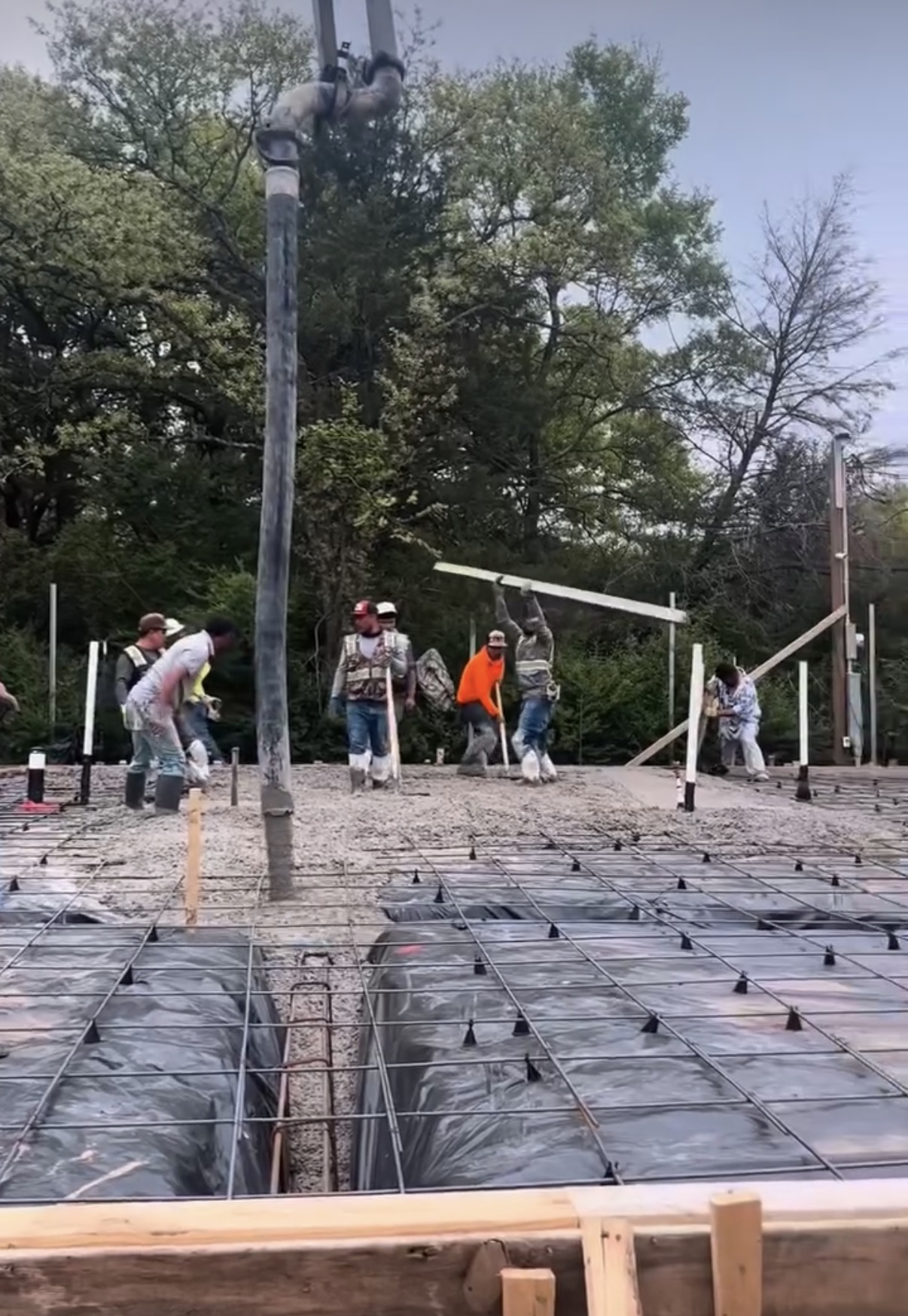
The foundation pour itself happens in a single day (for most residential builds), but the preparation takes longer. Forms are set, plumbing rough-ins are placed beneath the slab, reinforcement steel is laid, and then the concrete is poured and finished. After that, the slab has to cure — typically 7 days before framing begins, sometimes longer depending on weather.
Weather matters here. Concrete poured in extreme heat or cold cures differently than concrete poured in moderate conditions. A foundation pour that happens on a 105-degree Texas afternoon without proper precautions is not the same product as one poured at 75 degrees. Ask your builder how they handle pours in bad weather conditions.
Typical timeline: 1 to 2 weeks for prep and pour, plus curing time.
Phase 4: Framing
This is the phase most people picture when they think of a house being built. The lumber goes up, the structure takes shape, and for the first time you can walk through and see the rooms.
Framing covers the walls, floor systems (if there’s a second story or raised floor), roof structure, and sheathing. Window and door openings are framed in. The house goes from a slab to something that looks like a building.
A few things worth knowing about framing:
The quality of the framing crew matters more than most buyers realize. Walls that are out of plumb, improperly spaced studs, or incorrect header sizing above openings aren’t visible once drywall goes in — but they affect everything from how doors hang to how the roof performs over time.
This is also when rough electrical, plumbing, and HVAC start going in. Those trades work alongside the framing crew, running their lines through the walls before they’re closed up.
An inspection happens at the end of framing — before insulation or drywall covers anything. This is one of the most important inspections in the build. If something is wrong in the walls, this is the last easy chance to fix it.
Typical timeline: 4 to 8 weeks depending on size and crew.
Phase 5: Rough-ins — mechanical, electrical, and plumbing
“Rough-in” means the infrastructure of the house — all the pipes, wires, and ducts that run inside walls, ceilings, and floors before they’re covered up.
Plumbing rough-in includes supply lines, drain lines, and vent stacks. In DFW, some plumbing runs under the slab (which is why it’s installed before the pour) and some runs through the walls.
Electrical rough-in includes all the wiring runs — circuits for outlets, switches, lighting, appliances, the panel location, and any low-voltage work like data or audio.
HVAC rough-in includes ductwork, equipment platforms, and line sets for the air handler and condenser.
Each trade gets its own inspection before walls close. These inspections exist because once drywall goes up, fixing a problem in the rough-ins means cutting into finished walls. That’s expensive and adds time.
This phase is where the “you get what you pay for” reality of construction shows up most clearly. Cheap rough-in work is hard to spot until something leaks, trips a breaker, or the HVAC runs constantly because the duct layout is inefficient. The trades we use are people we’ve worked with for years. That matters.
Typical timeline: 3 to 5 weeks.
Phase 6: Insulation, drywall, and interior finishes
After rough-in inspections pass, the walls close up and the house starts to look like a home.
Insulation goes in first — in the walls, attic, and any other areas required by code. In Texas, attic insulation is especially important given the heat load.
Then drywall: hung, taped, mudded, and sanded. This takes longer than most people expect and involves multiple passes to get the surface ready for paint.
Then interior finishes, which is where most of the visible decision-making happens in a build-to-suit: flooring, cabinetry, countertops, tile, fixtures, trim, paint. This phase runs in a specific sequence — flooring after paint in some areas, tile before fixtures, trim after walls are done — and coordinating the trades to stay in sequence is one of the main jobs of the project manager.
This is also when exterior work is typically happening in parallel: siding or brick, windows, exterior doors, roofing if not already done, and landscaping prep.
Typical timeline: 6 to 10 weeks. This is usually the longest phase of the build.
Phase 7: Final inspections and certificate of occupancy
Before you get keys, the house has to pass a final inspection — actually, a series of them. The city or county inspector (and sometimes multiple inspectors from different departments) walks the finished home and signs off that it meets code.
Common items on a final inspection checklist:
- All electrical outlets and fixtures working correctly
- GFCI protection in kitchens, bathrooms, and exterior locations
- Smoke and carbon monoxide detectors installed per code
- Plumbing fixtures functional, no visible leaks
- HVAC operational and balanced
- Stairs, railings, and handrails to code if applicable
- Exterior grading directs water away from the foundation
Once inspections pass, the city issues a Certificate of Occupancy — the CO. Without a CO, the home legally can’t be occupied. Any builder who asks you to move in before the CO is issued is asking you to take on risk that’s theirs.
After the CO, you do a final walkthrough with the builder to document anything that needs to be addressed — punch list items. These should be in writing and resolved before or shortly after closing.
Typical timeline: 1 to 2 weeks for inspections and punch list.
Realistic timelines for DFW new construction
People ask us this constantly, and the honest answer is: it depends. But here’s a reasonable range based on what we see in DFW:
Spec home (already built or nearly finished): 30 to 60 days from contract to close — similar to buying a resale home.
Build-to-suit, straightforward lot and plan: 8 to 12 months from lot acquisition to certificate of occupancy.
Build-to-suit, complex lot, custom design, or permitting delays: 12 to 18 months.
Anyone quoting you 4 months on a ground-up custom build is either leaving something out or planning to move very fast through phases that deserve more time. Ask them which phases they plan to compress and why.
What to watch for at each phase
A few quick indicators that a build is going well — or isn’t.
Going well: The permit is posted on-site. The site is clean and organized between phases. Your builder answers your questions directly and doesn’t get defensive when you ask to see something. Inspections pass the first time.
Worth asking about: If you drive by and the site is quiet for two weeks with no explanation. If the builder tells you inspections are “in process” without specifics. If punch list items from a previous phase are still unresolved when the next phase starts.
Concerning: Being told inspections aren’t required for a particular item when you know they are. Subs on site who don’t know who the general contractor is. Being discouraged from visiting the site during construction.
You have the right to visit your build. A builder who makes that uncomfortable isn’t a builder you should be working with.
How CLCMC manages this process
We handle every phase in-house or with trades we’ve worked with for years. We pull all permits, manage all inspections, and are on-site throughout the build.
When you work with us on a build-to-suit, you get a realistic timeline before we break ground — not an optimistic one designed to win the contract. We’d rather set the right expectation upfront than manage a disappointed client for 12 months.
If you have a lot in DFW, or you’re trying to figure out whether a piece of land is worth building on, we’re happy to take a look and give you a straight answer.
CLCMC Investments is a family-owned home builder serving the Dallas–Fort Worth area. New construction spec homes, build-to-suit custom homes, and land clearing across DFW. (214) 434-2537 · clcmcinvestments@gmail.com