
Not every project starts from raw land.
Some of the most satisfying work we do starts with a property that’s been sitting — unmaintained, unloved, and written off by most buyers who walked through it. The kind of place where the carpet is stained, the walls are marked up, and whoever owned it last clearly stopped caring a while before they left.
Those properties are actually some of our favorites.
Because when you strip out what doesn’t work and build back what does, the result is something that genuinely surprises people. Not because we did anything exotic — but because the gap between where it started and where it ended up is hard to ignore.
This is the story of one of those projects.
Where it started
The property had been vacant for a while when we got involved. You could tell the moment you walked in.
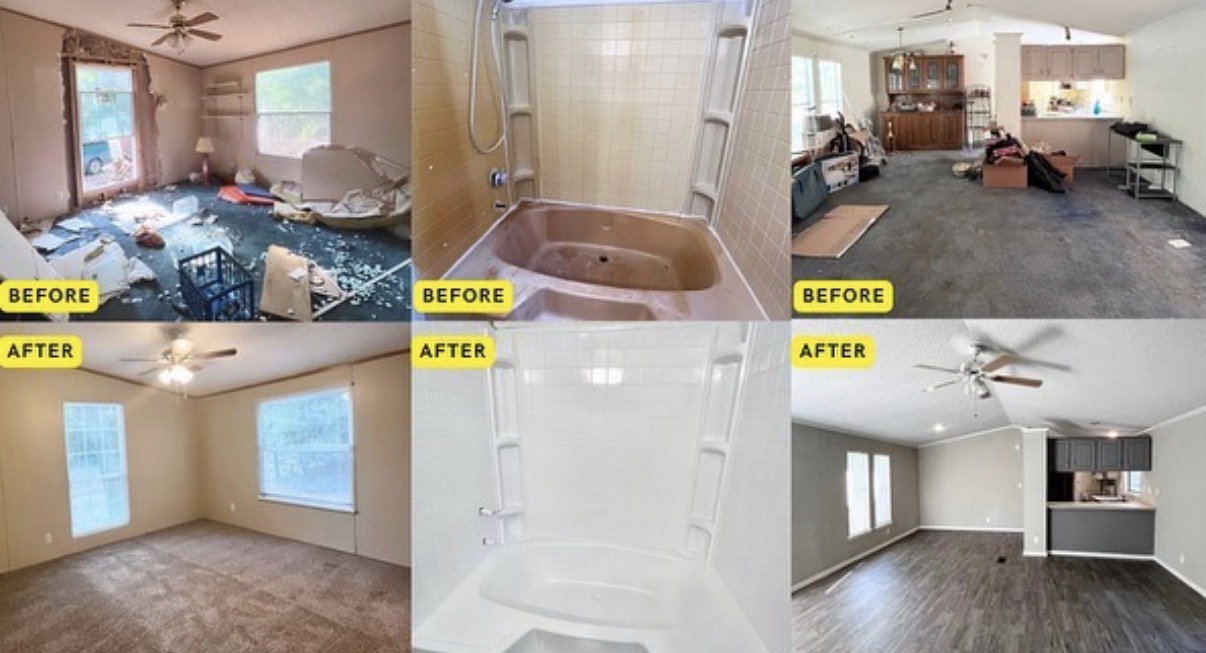
The living room had water damage along one wall — the kind that happens slowly when a roof issue doesn’t get addressed. The carpet was original to the house, which meant it was decades old, compressed flat, and a color that no longer exists in any catalog. One of the bedrooms had a hole in the drywall that had been patched with what appeared to be cardboard and paint. The kitchen cabinets were functional in the loosest sense of the word.
The bathrooms were the most dramatic part. Pink tile. A corner tub that had never been particularly useful and was now actively an eyesore. Fixtures that had corroded past the point of cleaning.
None of it was structural. That’s what made it worth doing.
The bones of the house were solid — the framing was good, the foundation was stable, and the layout actually made sense once you stopped looking at the surfaces. That’s the evaluation we do before we commit to any renovation project. Surfaces can be replaced. Structure is a different conversation.
The living room
Before: Water-stained walls, original baseboards pulling away from the floor, carpet that had absorbed 30 years of everything. One window that stuck and one that didn’t close all the way.
What we did: Pulled the carpet, addressed the moisture source before closing up the wall, replaced drywall in the affected area, retextured to match the rest of the room. New flooring throughout — LVP in a warm natural tone that works with the light the room gets in the afternoon. Fresh paint, new trim, windows resealed and operational.
After: The room is the same size it always was. It looks twice as large because the floor and walls are clean and consistent. The water issue is gone, not covered up.
The difference between a renovation done right and one done fast is whether you fix the problem or paint over it. We fixed it.
The kitchen
Before: Cabinets that had been painted over so many times the doors didn’t close cleanly. Countertops that had been patched in two places with mismatched material. A layout that worked but felt cramped because every surface was dark and dated.
What we did: New cabinet boxes where the structure was compromised, resurfaced and painted where the boxes were solid. New countertops — quartz, which holds up better in a kitchen than laminate and doesn’t need sealing. New hardware throughout. New backsplash. The appliances were replaced with a matching set in stainless — nothing custom, just clean and consistent.
After: Same footprint. Completely different room. When the cabinets are white and the counters are light, a small kitchen reads as a functional kitchen rather than a cramped one. That’s not a trick — it’s just what happens when the surfaces stop fighting each other.
The bathrooms
This was the most dramatic transformation in the house, which is almost always the case.
Before: The primary bathroom had pink tile from floor to ceiling, a corner tub that took up a third of the room, and a vanity with a single sink and a mirror that had been glued directly to the wall. The guest bathroom was in better shape but still had fixtures from a previous decade and flooring that had lifted in two corners.
What we did: In the primary, the tub came out entirely. That single decision opened up the room. We retiled floor to ceiling in a large-format gray tile — the kind that reads clean and modern without trying too hard. Double vanity with new fixtures, frameless mirror, updated lighting. Walk-in shower with a niche, linear drain, and a rain head.
In the guest bath, new flooring, new vanity, new fixtures. The tile stayed because it was in good shape — we just made everything around it consistent.
After: The primary bathroom is the room that stops people. Not because it’s extravagant — it isn’t. Because it looks like it belongs in a home someone takes care of. That’s the standard we aim for.
The bedrooms
We kept the work here intentional and minimal. New flooring to match the rest of the house. Fresh paint — a neutral that photographs well and doesn’t compete with furniture. New closet systems in both bedrooms to replace the single rod and shelf that was original.
The hole in the drywall got a proper patch, not a cosmetic one. New window treatments. That’s mostly it.
Bedrooms are rooms people sleep in. They don’t need to be complicated. They need to be clean, functional, and finished consistently with the rest of the house.
What the whole project took
Start to finish, this renovation ran about 11 weeks. That’s longer than a quick flip and shorter than a ground-up build.
The timeline broke down roughly like this:
- Week 1–2: Demolition, moisture remediation, structural assessment
- Week 3–4: Rough-in updates (electrical brought up to current code, plumbing in the bathrooms)
- Week 5–7: Tile, drywall, flooring
- Week 8–9: Cabinets, counters, fixtures
- Week 10–11: Paint, trim, punch list, final walkthrough
No phase started before the previous one was done correctly. That matters more than it sounds. When trades work on top of each other to save time, you end up fixing things twice.
What made this project work
Three things, and they apply to almost every renovation we do.
We assessed the structure before we committed to anything. A property with bad bones will absorb money without getting better. This one had good bones. We knew that before we started the clock.
We fixed problems, not appearances. The water damage in the living room could have been painted over. It wasn’t. When you renovate a house, the next person living in it is trusting that the work underneath the surfaces was done right. We build with that in mind.
We kept the decisions consistent. Flooring that runs through the whole house. Fixtures in the same finish. Hardware that matches. Paint colors that work together. None of that is expensive. All of it makes the difference between a house that looks renovated and one that looks finished.
The result
A home that was written off is now move-in ready.
The people who walked through before we started saw problems. The people who walk through now see a house they’d want to live in. That gap is what the work is for.
If you have a property in DFW that’s been sitting, or you’re looking at a distressed home and wondering whether it’s worth doing — we’re happy to take a look and give you a straight answer. Sometimes it is. Sometimes it isn’t. Either way, you’ll know what you’re working with.
CLCMC Investments is a family-owned home builder serving the Dallas–Fort Worth area. New construction spec homes, build-to-suit custom homes, and land clearing across DFW. (214) 434-2537 · clcmcinvestments@gmail.com